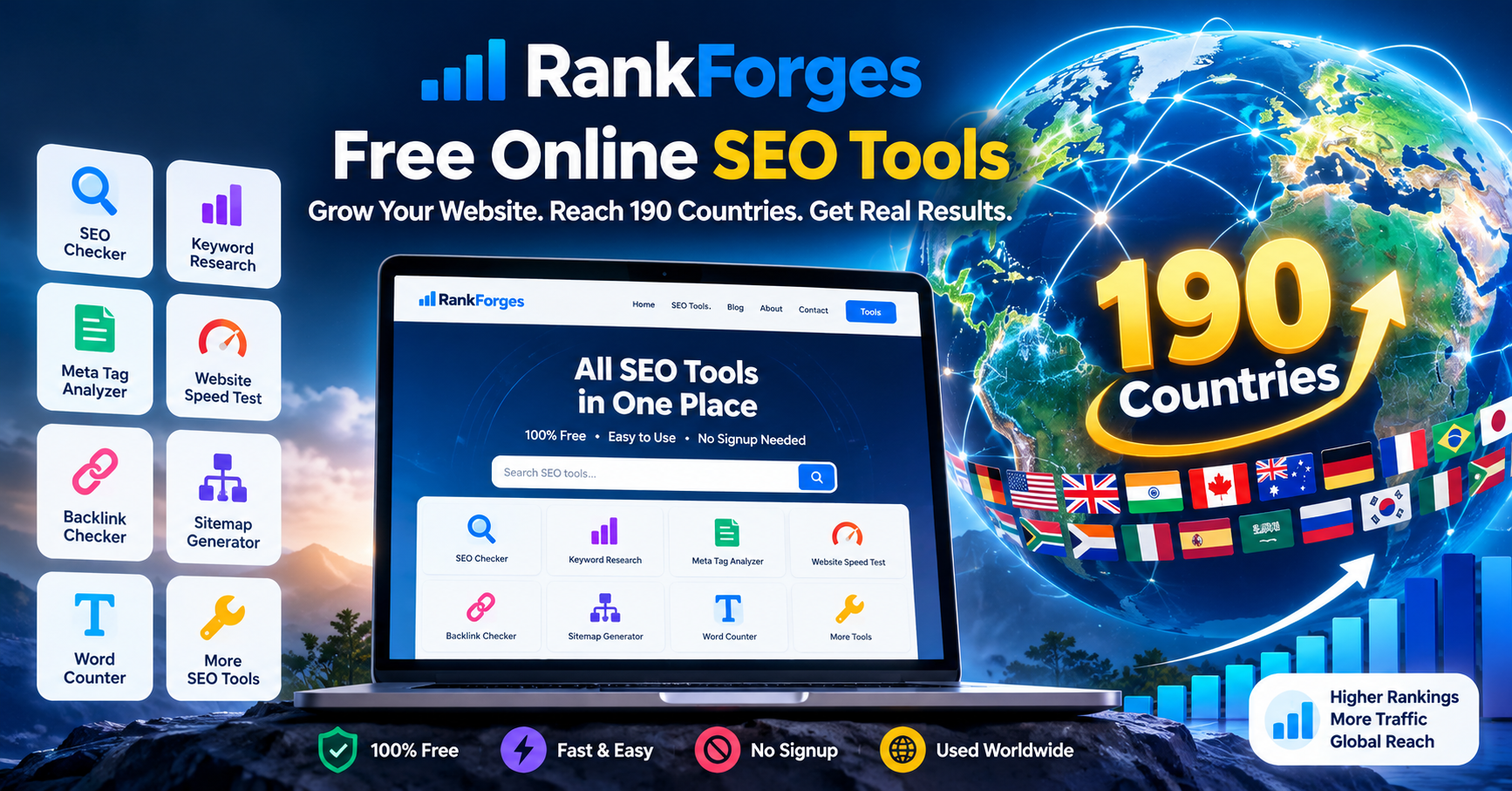
Every website owner wants more visitors. Some want to sell products, some want to find new customers, and others want to share their knowledge with the world. But getting visitors from search engines can be difficult, especially when you are just starting.
This is where free online SEO tools can help.
SEO stands for Search Engine Optimization. It means improving your website so search engines can understand your pages and show them to people searching for related information.
You do not need to be a technical expert to start. With the right tools, you can check your website, find useful keywords, improve your content, and discover problems that may affect your search visibility.
In this guide, you will learn what SEO tools do, how to use them, and how to build a simple SEO plan for a website targeting readers in different countries.
What Are Free Online SEO Tools?
Free online SEO tools are web-based tools that help you understand and improve your website's performance in search engines.
You can often use them directly in your browser without installing software. Depending on the tool, you may be able to check page titles, count words, review keyword use, test page speed, or create an XML sitemap.
These tools can save time and make SEO easier for beginners.
For example, imagine that you have written a blog post about digital marketing. You have published it, but it is not getting visitors from Google.
An SEO checker may help you find a missing page title, an unclear heading structure, or other issues worth reviewing. A keyword tool can help you understand what people might search for when looking for that topic.
The tools provide useful information, but you still need to decide which changes make sense for your website.
Why Is SEO Important for Every Website?
Search engines help people find information, products, services, and solutions to everyday problems.
If your website provides a useful answer, SEO can help the right people discover it.
Here are some important benefits of SEO.
1. Get More Relevant Visitors
SEO can bring visitors who are already interested in your topic.
For example, a person searching for "how to improve website speed" may want practical advice. A clear guide that answers this question can attract that person to your website.
Relevant visitors are often more valuable than random traffic because they have a clear reason to visit.
2. Build Trust With Readers
People want websites that are easy to use and provide reliable information.
Clear headings, helpful content, working links, and accurate details can create a better experience. Over time, useful content may help readers trust your website and return for more information.
3. Improve Your Content
SEO tools can show where your content needs work.
You may discover that a page has no clear title, uses the same keyword too often, or lacks answers to common questions.
Fixing these issues can make your content easier to understand for both readers and search engines.
4. Support Long-Term Growth
Paid advertising can bring traffic while a campaign is running. SEO works differently.
A useful page may continue to attract visitors for months or years if it remains relevant and competitive. However, rankings can change, so regular reviews and updates are important.
SEO takes time. It is not a shortcut to instant success.
Types of Free Online SEO Tools You Should Know
Different tools solve different problems. You do not need to use every tool on the internet. Start with the ones that match your needs.
1. On-Page SEO Checker
An on-page SEO checker reviews important elements of a web page.
Depending on its features, it may check:
- Page title and meta description
- Main headings and subheadings
- Keyword placement
- Image alternative text
- Internal links
- Basic page structure
For example, your article may have a title that does not clearly explain the topic. Improving that title can help readers understand what the page offers before they open it.
Do not change every element just to achieve a perfect score. Focus on changes that improve clarity and usefulness.
2. Keyword Density Checker
A keyword density checker counts how often a word or phrase appears in your content.
Suppose your main keyword is "free online SEO tools." If you repeat it in every paragraph, the article may sound unnatural.
The goal is not to reach a magic keyword percentage. Search engines do not require one universal keyword density for every page.
Use your main keyword where it fits naturally, then include related terms when they help explain the topic.
3. Meta Tag Analyzer
Meta tags provide information about a web page. Two important elements are the SEO title and meta description.
The title helps explain the page's topic. The meta description provides a short summary that may appear in search results.
A good title should be clear and relevant. A good description should explain what readers will learn without making promises the page cannot deliver.
For example:
Title: Free Online SEO Tools: A Beginner's Guide
Description: Learn how to check website SEO, improve content, research keywords, and find common website issues with online tools.
Write a different, useful title and description for each important page.
4. Website Speed Checker
Website speed affects how people experience your website.
A slow page can frustrate visitors, especially when they use a mobile phone or a weak internet connection.
A speed checker may help you identify large images, unnecessary scripts, or other performance issues.
To improve loading speed:
- Compress large images.
- Use modern image formats where suitable.
- Remove plugins and scripts you do not need.
- Enable suitable caching.
- Choose reliable hosting.
- Test your website on mobile devices.
A speed score is useful, but the real goal is to create a fast, stable experience for visitors.
5. Sitemap Generator
A sitemap is a file that lists important URLs on your website.
An XML sitemap can help search engines discover pages, especially on large or frequently updated websites.
After creating a sitemap, check that it contains the correct URLs and does not include pages you do not want indexed.
You can then submit it through Google Search Console.
Remember that submitting a sitemap does not guarantee that every listed page will be indexed.
6. Word Counter
A word counter tells you how many words appear in your content.
It can also help you review character counts and sentence length, depending on the tool.
There is no single ideal word count for every blog post.
A simple question may need only 500 words. A detailed guide may need 2,000 words or more. Choose a length that answers the reader's question fully without adding unnecessary paragraphs.
7. Content Quality and Readability Checker
A readability checker can help you find long sentences, difficult words, and paragraphs that are hard to follow.
This is useful if your audience includes beginners.
Try to explain technical terms in plain English. Break long paragraphs into smaller sections. Use examples whenever an idea might be confusing.
Your content should sound natural when read aloud.
8. DNS Lookup and Technical Tools
Technical tools help website owners investigate problems beyond the written content.
A DNS lookup tool can show information about domain name records. Other utilities may help you check URLs, encode text, or review website configuration.
These tools are useful when a website has connection problems or when you need to understand its technical setup.
If you are not sure what a setting does, research it before changing important records.
How to Use SEO Tools Step by Step
You can build a simple SEO routine without making the process too complicated.
Step 1: Choose One Main Topic
Start with a clear question or problem.
For example, if you run a website for beginners, you might choose "how to improve website SEO."
Before writing, think about what a reader expects to learn.
Step 2: Research Search Keywords
Find the words people may use when searching for your topic.
Look at relevant search suggestions, related questions, and competing pages.
Separate your keywords into three groups:
- Main keyword: The central topic of your article.
- Related keywords: Phrases that explain connected ideas.
- Question keywords: Specific questions your article should answer.
Choose terms that match the same search intent rather than adding unrelated keywords just because they have traffic.
Step 3: Create a Useful Outline
Organize your article with a clear H1 heading and logical H2 and H3 subheadings.
A simple outline might include:
- What SEO means
- Why SEO matters
- Tools beginners can use
- How to improve a website
- Common mistakes
- Frequently asked questions
This structure helps you cover the topic without repeating the same information.
Step 4: Write for People First
Explain the topic in your own words. Use examples, practical steps, and accurate information.
Avoid copying competing articles or adding paragraphs only to increase word count.
If you use AI to help with research or drafting, review every important claim and add real experience or useful details. The final article should provide value beyond a basic summary of information already available online.
Step 5: Check the Page Before Publishing
Use relevant SEO tools to review the page title, description, headings, images, links, and readability.
Open the article on a phone as well as a computer.
Make sure the page loads properly, the text is easy to read, and the links work.
Step 6: Track Results
Connect your website to Google Search Console.
Review impressions, clicks, search queries, and average position. These figures can help you understand which pages are being discovered and which topics may need improvement.
Use the results to make decisions rather than changing your strategy every day.
Can SEO Help Your Website Reach Readers in 190 Countries?
Yes, SEO can help a website reach an international audience. However, publishing one article does not automatically make it rank in 190 countries.
Each market may have different languages, search habits, competitors, and user needs.
If you want to reach readers around the world, begin with a clear international SEO plan.
1. Use Language That Your Audience Understands
English can be useful for reaching people in many markets, but it is not the first language of every internet user.
If you have the resources, consider creating high-quality translations for audiences that search in other languages.
Do not publish hundreds of low-quality translated pages simply to cover more countries.
2. Understand Local Search Intent
People in different countries may use different phrases for the same problem.
Research local search terms before creating country-specific content.
For example, a guide for a local service business may need details about prices, rules, or service areas that differ from one country to another.
Only create separate country pages when they provide information that is genuinely useful to that audience.
3. Make Your Website Easy to Use Worldwide
Your website should work well on mobile devices and load reliably for visitors in different regions.
Use clear navigation, readable text, descriptive links, and compressed images.
If your website serves several languages or regions, use an appropriate URL structure and correctly configured language signals where needed.
4. Build Authority Naturally
Useful resources may earn links when other websites find them worth sharing.
You can support this by publishing original research, practical guides, clear explanations, and helpful tools.
Avoid buying large numbers of low-quality backlinks or creating unrelated pages just to target more keywords.
5. Measure Each Market
Use available search performance data to see where your pages receive impressions and clicks.
Compare results by country, query, and page. Look for real opportunities instead of assuming that every country will produce the same results.
International SEO is an ongoing process. Progress depends on your content, competition, website quality, and the needs of your audience.
Common SEO Mistakes to Avoid
Even useful tools cannot fix every problem. Avoid these common mistakes when improving your website.
Keyword Stuffing
Repeating a keyword too many times can make your writing difficult to read.
Use natural language and include related terms only when they help explain the subject.
Copying Other Websites
Copying another article does not give readers a strong reason to visit your page.
Research competing content to understand the topic, then create something more useful through better explanations, original examples, or updated information.
Publishing Too Many Low-Quality Articles
Publishing more pages does not always lead to more traffic.
A smaller number of helpful articles can be more valuable than hundreds of pages with little original information.
Ignoring Mobile Users
Many visitors browse websites on phones. If text is too small, buttons do not work, or pages load slowly, people may leave.
Test the mobile experience before publishing important content.
Expecting Instant Rankings
SEO results vary from one website to another.
New pages may take time to be discovered, indexed, and shown prominently in search results. Competitive topics may require ongoing work.
Be patient and use real performance data to guide improvements.
Trusting Every Tool Score
An SEO score is a guide, not a promise of rankings.
Different tools use different checks and scoring systems. A high score does not guarantee first-page placement, and a lower score does not mean every suggestion needs to be applied.
Use your judgment and focus on the issues that matter most.
How RankForges Can Help With Your SEO Workflow
RankForges brings practical online tools together to help users handle common website and content tasks.
Depending on the tools available on the website, you can use it as a starting point for checking page elements, reviewing keyword use, counting words, and working through everyday SEO tasks.
A simple workflow can make the process easier:
- Research your topic and identify the reader's main question.
- Write a clear, useful article.
- Review its page elements and readability.
- Fix important technical or content issues.
- Publish the article and track its search performance.
- Update it when the information becomes outdated or new questions arise.
Visit RankForges.in to explore the tools available for your workflow.
The best results come from combining practical tools with careful research, useful content, and regular improvements.
Frequently Asked Questions
1. What are the best free online SEO tools for beginners?
Start with tools that help you review page titles, meta descriptions, keywords, readability, and website performance. Google Search Console is also useful for checking search impressions, clicks, and indexing information.
2. Can free SEO tools help my website rank on Google?
Yes. They can help you identify problems and improve your pages. However, rankings also depend on relevance, competition, website quality, and many other factors.
3. How long does SEO take to show results?
There is no fixed timeline. Some pages may begin receiving search impressions relatively quickly, while competitive keywords can take much longer to gain visibility. Measure progress over time rather than expecting instant results.
4. How many keywords should I use in one article?
Focus on one main topic and include related phrases naturally. There is no universal number of keywords that guarantees good rankings.
5. Does a longer blog post rank better?
Not automatically. A longer article is useful when the topic needs a detailed explanation. Shorter content can perform well when it answers the question clearly and completely.
6. Can AI help with SEO content writing?
AI can help with research, outlines, editing, and drafting. You should still verify facts, improve the writing, add original value, and make sure the article meets your readers' needs.
7. Can I rank in multiple countries with one website?
Yes. A website can attract visitors from multiple countries. Success depends on language, search intent, competition, technical setup, and content quality. Separate country pages should be created only when they offer meaningful local value.
8. Does an AI detector determine whether content is good for SEO?
No. AI detectors attempt to estimate how text was produced, but their results are not fully reliable. Good SEO content should be accurate, useful, original, clear, and written for its intended audience.
9. Should I update old blog posts?
Yes, when updates are useful. Correct outdated information, improve unclear sections, fix broken links, and add new details when they genuinely help readers.
10. What is the first step toward better SEO?
Start by understanding your audience and the question they want answered. Then create a useful page, check its technical basics, and track how people find it.
Free Online SEO Tools for 190 Countries: A Global Guide
People around the world use search engines to find website tools, improve content, research keywords, and solve technical problems. However, their needs and search habits may differ by country.
RankForges aims to serve website owners, bloggers, developers, students, and digital marketers from different parts of the world.
Whether you are building a website in India, running an online business in the United States, publishing a blog in the United Kingdom, or managing a website in Australia, the basic goal remains the same: create useful pages that people can find and understand.
SEO Tools for Asia
Website owners in India, Pakistan, Bangladesh, Nepal, Sri Lanka, Singapore, Malaysia, Indonesia, Thailand, Vietnam, Japan, South Korea, the Philippines, and other Asian markets may use SEO tools to research keywords, improve content, and check technical issues.
If you target these markets, consider local search terms, language preferences, mobile performance, and the needs of your audience.
SEO Tools for Europe
Businesses and content creators in the United Kingdom, Germany, France, Italy, Spain, the Netherlands, Switzerland, Sweden, Norway, Poland, Portugal, and other European markets may need keyword research, website analysis, and content optimization tools.
For multilingual audiences, consider creating helpful content in the languages your visitors use.
SEO Tools for North America
Website owners in the United States, Canada, and Mexico can use SEO tools to understand search demand, review website performance, and improve their content.
Research the phrases your audience actually uses instead of assuming that one keyword works equally well in every market.
SEO Tools for South America
Businesses in Brazil, Argentina, Chile, Colombia, Peru, Ecuador, Uruguay, and other South American markets may benefit from localized keyword research and relevant content in Spanish or Portuguese.
Accurate translations and locally useful examples can make your pages more helpful.
SEO Tools for Africa
Bloggers and businesses in South Africa, Nigeria, Kenya, Egypt, Ghana, Morocco, Ethiopia, Tanzania, Uganda, and other African markets can use website tools to improve their technical SEO and content quality.
Consider mobile access, connection speed, language preferences, and the questions people in each market want answered.
SEO Tools for Australia and Oceania
Website owners in Australia, New Zealand, Fiji, Papua New Guinea, Samoa, and other Pacific markets can use SEO tools to check page quality, research keywords, and improve website performance.
Local search terms and audience needs should guide the content you publish.
How to Target 190 Countries With One Website
You do not need to create 190 separate websites to reach an international audience. Start with a strong main website and useful content that answers questions people across different markets share.
Follow these steps:
- Research international demand. Use keyword research and search performance data to identify countries where people are searching for your topics.
- Create globally useful content. Write clear guides that solve real problems without relying on country names to fill space.
- Localize when needed. Create translated or country-specific pages when they provide genuinely useful information for that audience.
- Use the right URL structure. Organize language and regional versions clearly. Use appropriate
hreflangannotations when you have localized versions of a page. - Improve website performance. Make pages mobile-friendly, fast, accessible, and easy to navigate.
- Track country-level results. Review impressions, clicks, and queries in Google Search Console to find markets where your content is gaining visibility.
- Keep improving. Update outdated information, fix technical problems, and publish content that reflects real user needs.
The aim is not simply to mention 190 countries in one article. The aim is to make RankForges useful to people in those markets and give search engines clear signals about the content and its intended audience.
Explore the tools available at RankForges.in and build an SEO workflow that can grow with your website and your international audience.
Important: International SEO can help you reach people across many countries, but rankings depend on content quality, competition, technical setup, language, and search intent. No tool or article can guarantee rankings in every country.
Final Thoughts
Growing a website through search engines takes planning, patience, and consistent work. Free online SEO tools can make that process easier by helping you find problems, improve content, and understand your website's performance.
You do not need to master every SEO concept on your first day. Start with one page, make a few meaningful improvements, and learn from the results.
If your goal is to reach readers across different countries, focus on clear language, useful information, good website performance, and content that fits the needs of each audience.
Better SEO starts with helping people find the right answer. Use tools to support that goal, and keep improving your website as you learn more about your readers.